Skip to content



The implementation of artificial intelligence in the public sector and the need for governance frameworks adapted to the region’s institutional contexts were at the center of the regional dialogue convened by the German Development Cooperation and the Economic Commission for Latin America and the Caribbean (ECLAC), within the framework of the Digital Transformation for Regional Integration (D4R) project.
The activity brought together 552 participants from 48 countries and 162 institutions, consolidating itself as a regional space for exchange on digital public policy that expanded its reach beyond the Caribbean. The highest participation came from Trinidad and Tobago, Jamaica, Guyana, Antigua and Barbuda, and Barbados, with representatives from ministries, digital government agencies, regulators, and international organizations.
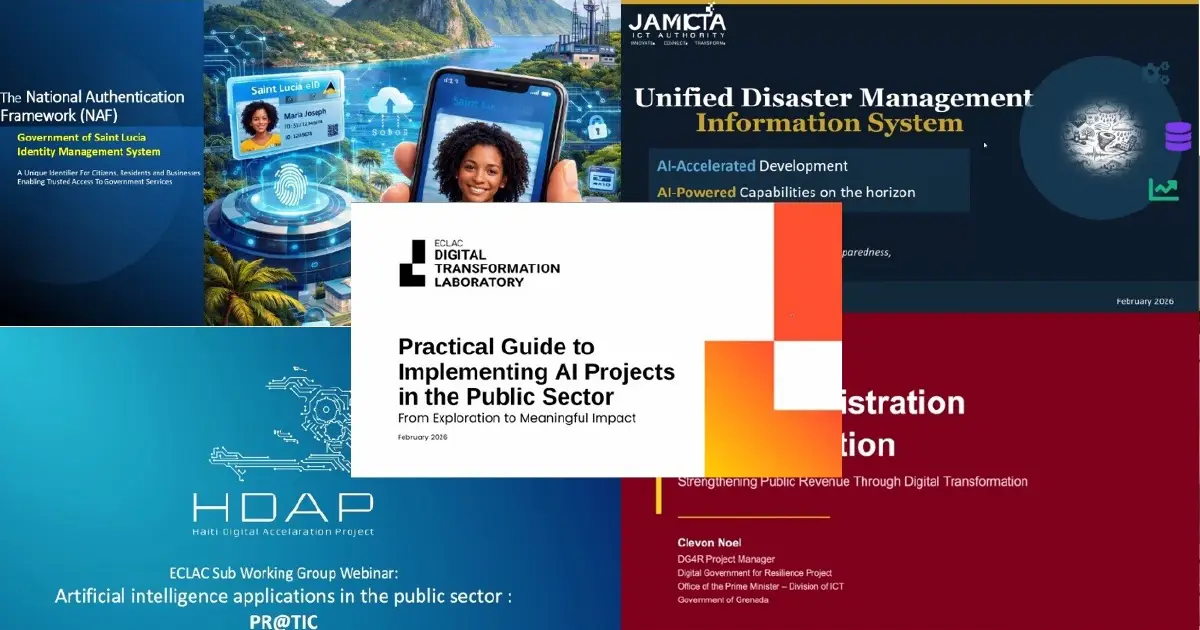
During the day, public institutions from Antigua and Barbuda, Grenada, Haiti, Jamaica, Saint Lucia, Saint Vincent and the Grenadines, and Trinidad and Tobago presented national experiences in areas such as migration control, tax administration, education, emergency management, and digital identity. The cases presented showed concrete progress in administrative efficiency and access to services, while also highlighting the need for stronger institutional coordination, proper data management, and risk assessment mechanisms.
In this context, ECLAC’s Digital Transformation Lab (DLAB) presented a practical guide for implementing artificial intelligence projects in the public sector. The tool proposes a structured process that enables institutions to identify the public problem to be addressed, assess their institutional capacities, and define responsible-use principles before adopting specific technological solutions.
The dialogue made it possible to share lessons learned among countries and align initiatives with a common working framework. As a result, participating institutions now have an operational reference for designing and evaluating artificial intelligence projects aimed at improving the quality of public services and strengthening government decision-making.
The activity reaffirms ECLAC’s and the German Development Cooperation’s commitment to supporting countries in the region in building institutional digital capacities, with special attention to inclusion, transparency, and sustainable productive development.